
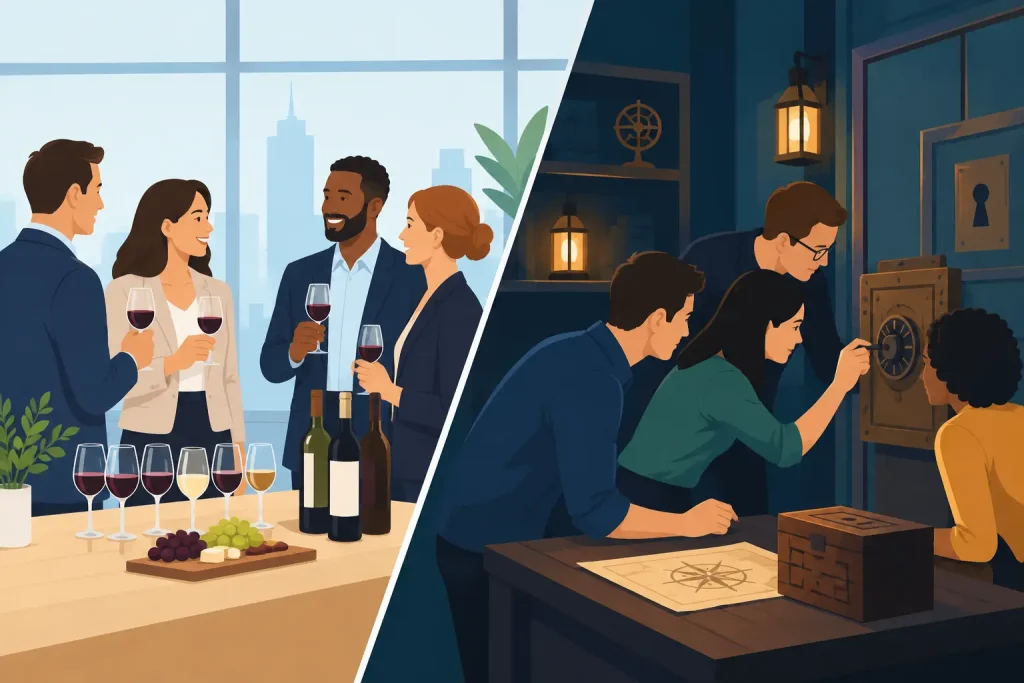
The usual team-outing problem starts in a group chat: someone suggests an escape room, someone else asks about dinner, and suddenly the person organizing it has six opinions, three dietary restrictions, and no clear plan. When comparing corporate tastings versus escape rooms, the better choice is not simply about whether your team prefers clues or cabernet. It is about the kind of connection you want to create, how much planning your team can take on, and whether the experience feels welcoming to everyone in the room.
Both options can get people away from their desks and give them something to talk about besides deadlines. But they create very different energy. An escape room asks colleagues to solve a problem together under pressure. A guided craft beverage tasting creates room to relax, swap stories, try something new, and enjoy the city or region you call home.
Corporate Tastings Versus Escape Rooms: The Real Difference
Escape rooms are built around a mission. Teams enter a themed space, find hidden clues, solve puzzles, and race against the clock. For a group that thrives on friendly competition, clear roles, and high-energy problem-solving, that can be a genuine hit. The shared win of escaping with two minutes left can be memorable.
The trade-off is that escape rooms can also put workplace dynamics on display. One or two highly competitive people may take over. Guests who dislike puzzles, enclosed rooms, jump scares, or being “on” in front of coworkers may quietly count the minutes until it is over. If your group is large, you may need to split into separate rooms, which can undercut the point of bringing everyone together.
A corporate tasting works differently. Instead of placing the group inside one challenge, it gives them a shared experience with more natural ways to participate. Guests can compare a citrusy IPA with a crisp local cider, talk with a distiller about a small-batch spirit, or learn why one winery uses a particular grape. Conversation has somewhere easy to go, even among colleagues who do not know one another well.
That slower, more social pace is especially useful for teams that are hybrid, newly formed, client-facing, or spread across departments. There is no requirement to perform. People can join a trivia question, chat at their table, enjoy the view from a venue, or simply savor the outing at their own pace.
Choose an Escape Room When the Goal Is Team Problem-Solving
An escape room makes sense when you have a compact group and a specific goal: encouraging collaboration, revealing different working styles, or breaking up a meeting-heavy day with a burst of energy. It is an easy fit for teams that already enjoy games, competition, and a little pressure.
It can also be a strong choice when the activity itself needs to stay short. Most experiences run about an hour, which leaves room for a separate lunch, dinner, or meeting. Just remember that the short activity does not always mean a short planning process. You may still need to coordinate transportation, meals, time slots, group assignments, and a place to gather afterward.
Before booking, ask whether everyone will be able to participate comfortably. Consider mobility needs, sensory sensitivities, language barriers, claustrophobia, and the fact that some teams simply do not want to spend their social time racing a countdown clock. A great team event should challenge people by choice, not make them feel trapped by the agenda.
Choose a Corporate Tasting When the Goal Is Connection
A guided brewery, winery, distillery, or cidery outing is often a better fit when the real goal is relationship-building. It provides structure without making the group feel over-programmed. There is a host, a route, reserved stops, and a clear plan, but the best moments happen in the spaces between: a new employee finding common ground with a senior leader, a sales team laughing over local trivia, or a client feeling genuinely welcomed.
Corporate tastings are not only for serious beer, wine, or spirits fans. In fact, a well-planned tour works because it removes the intimidation factor. Guests can ask basic questions, sample at their comfort level, and discover what they actually enjoy. The person who always orders the same drink may leave with a favorite local cider. The craft enthusiast gets more context and insider access than they would from a standard bar visit.
For groups in Boston, Providence, Newport, and the South Coast, the local setting is part of the value. A tasting can turn a familiar city into a fresh experience, especially when the itinerary includes venues people have meant to try but never quite got around to visiting. With transportation, reservations, samples, and hosting handled in advance, the organizer gets to be part of the outing instead of managing it from the sidelines.
Inclusivity Matters More Than the Activity
A tasting should never create pressure to drink. The strongest corporate outings make space for everyone, including guests who do not drink alcohol, are pregnant, are in recovery, are taking medication, or simply prefer not to participate in alcohol service. Thoughtful planning can include nonalcoholic craft options, food pairings, and venues where the experience is about flavor, local stories, and company rather than consumption.
That is one reason a guided tasting can be more flexible than people assume. Participation is not all-or-nothing. Someone can enjoy a mocktail, a soft drink, a meal, the venue atmosphere, and the conversation while their teammates sample. The point is shared time, not how much anyone drinks.
Escape rooms have their own inclusion questions. They are alcohol-free by default, which can be useful for organizations with strict policies. But accessibility still requires attention. Ask about physical layout, lighting, noise, puzzle formats, and whether every participant has a meaningful way to contribute. Neither option is automatically inclusive. The details determine whether people feel considered.
Compare the Planning Load, Not Just the Ticket Price
A single escape-room ticket may look straightforward, but the full event cost can grow once you add transportation, food, post-game drinks, and the staff time required to coordinate it all. Corporate planners should look beyond the initial price and ask a simpler question: what will it take to turn this into a complete, enjoyable outing?
A customized tasting tour can package many of those moving parts together. Transportation means no designated driver and no coordinating carpools. Reserved seating reduces the risk of a group showing up to a crowded venue with nowhere to sit. A planned route prevents the awkward gap between stops when people are searching maps and debating where to go next.
That convenience matters even more when alcohol is part of the event. Safe transportation is not an add-on or an afterthought. It is central to a responsible company outing. A hosted experience lets your group enjoy the occasion while ensuring everyone has a reliable ride and a clear schedule.
For corporate groups, Sip Happens Tours can customize the pace, beverage stops, meals, transportation, and hosting around the occasion. That can be especially useful for a team celebration, a client event, an off-site afternoon, or a holiday gathering where the organizer needs the experience to feel polished without becoming formal.
Think About What Happens After the Event
The best corporate outings create an afterglow. People reference a funny moment in a meeting the next week, share photos, or make plans to return to a place they discovered together. Escape rooms tend to deliver one big story: Did we get out? Who found the final clue? That can be great, particularly for teams that love a clean victory-or-defeat narrative.
Tastings tend to create more small stories. Someone discovers a new favorite pour. A coworker learns the difference between a sour beer and a cider. The group gets a behind-the-scenes look at how a local producer operates. Those moments are less scripted, which often makes them easier to revisit later.
If you need a competitive team-building exercise, choose the escape room and lean into the challenge. If you want people to relax, mingle across roles, enjoy local flavor, and leave feeling looked after, a corporate tasting is usually the stronger move. The right outing is the one that makes your people feel like the plan was made with them in mind – not simply made to fill a calendar slot.